It could easily be argued that bog bodies tend to capture the public imagination due to the exceptional preservation of their skin; the face of the Tollund Man, for example, is significantly less alarming to look at than even some other types of mummified remains, making him an ideal candidate for display in a museum. This is not the case for all bog bodies, which exist on a spectrum that ranges from well-preserved enough to take a fingerprint to entirely skeletonized, depending on the circumstances of their burial (time of year, depth, variety of peatland, etc.) as well as preservation efforts undertaken post-exhumation.
The Archäologisches Landesmuseum at Schloss Gottorf in Schleswig, Germany displays bog-preserved remains that exist at various points on this spectrum.
General Notes on the Exhibit
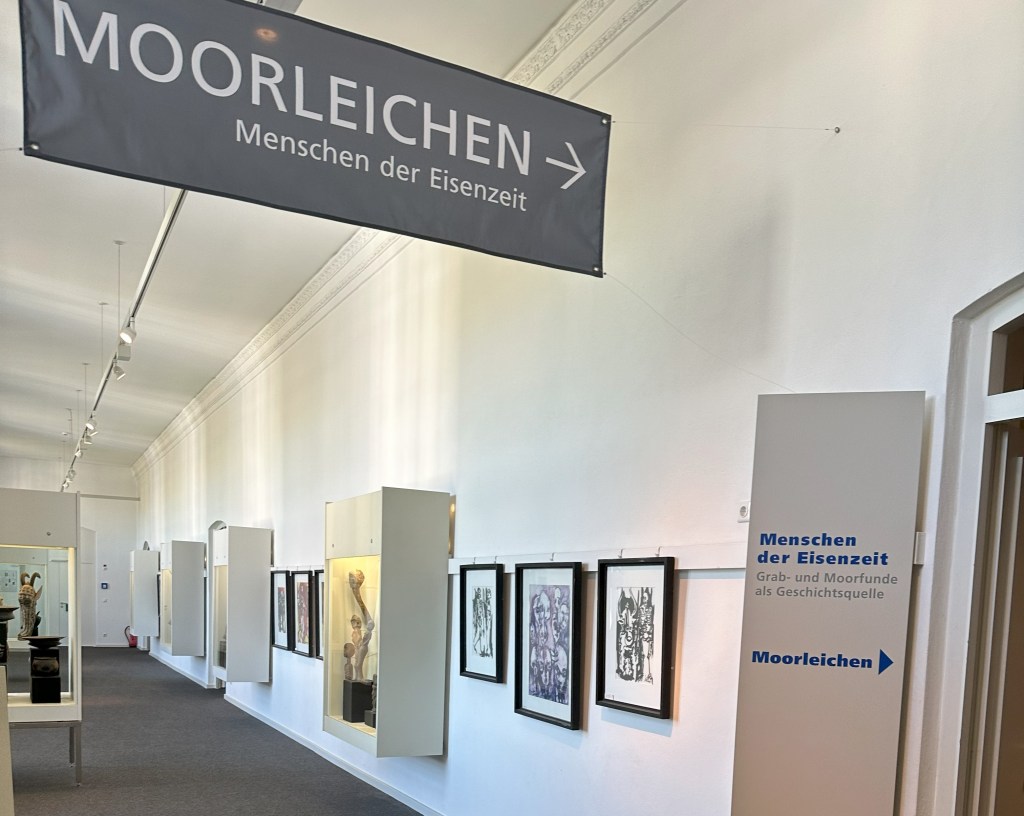
It was apparent upon purchasing tickets that the museum considers its notable collection of bog bodies to be one of the main attractions. The cashier, upon handing me the map, circled the rooms where I could visit the bog bodies without my having mentioned any special interest in them.
There are two exhibits relevant to bog-related finds. The majority of the bodies are presented in an exhibit titled Moorleichen: Menschen der Eisenzeit which translates to “Bog Bodies: People of the Iron Age.” Unlike the museums in Denmark, which frequently included versions of the text in Danish, English, and occasionally in German, the labels at the Moorleichen exhibit were in German only. This was not surprising; I got the impression while spending the week in Schleswig-Holstein that it was not as popular of an international tourist destination as some other German states (e.g., Bayern, or city-states like Hamburg).
As far as how this impacted my experience as a museum-goer, my knowledge of German was sufficient enough to understand most of the signage. I did note, however, that my husband (an archeology student who speaks some limited German) had trouble engaging with the displays without my help translating the labels, especially those that were text-heavy. Many of the docents spoke languages other than German and were available to assist visitors and answer questions throughout the museum.
I would describe the exhibit as being somewhat text-heavy. The label for each body includes a few contextual paragraphs, which I will touch on separately. There are additional labels describing the Iron Age as a whole and theories about why these bodies were buried in bogs in the first place.


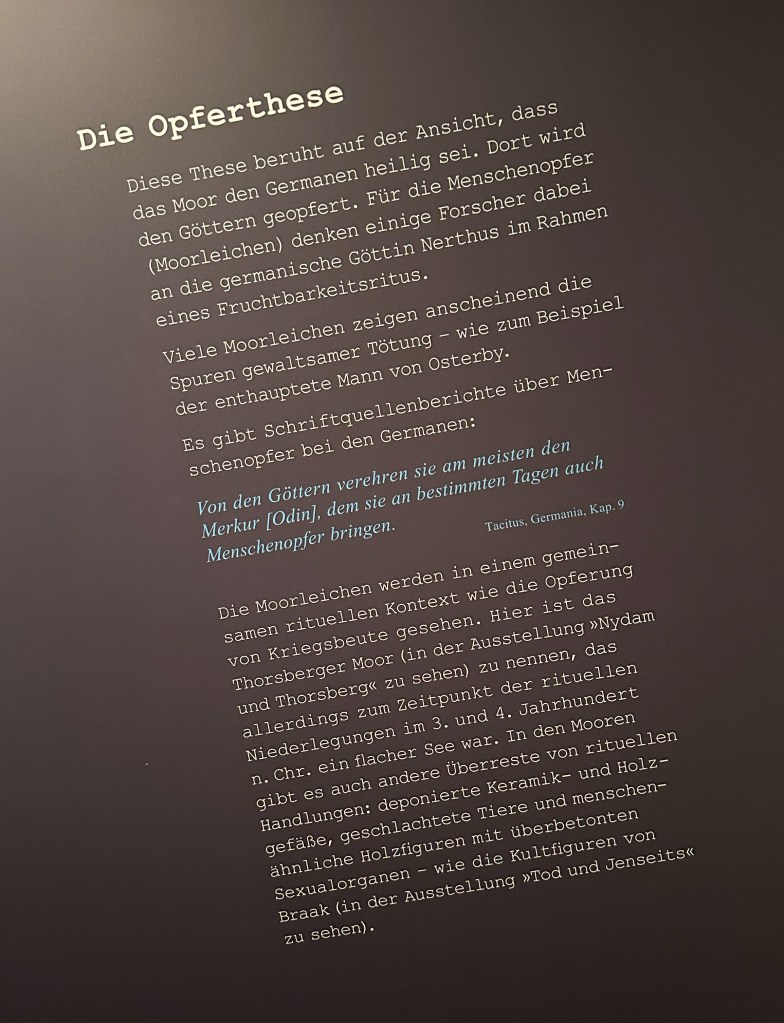
One placard—that which touts the possibility that bog burials were a punishment, as opposed to serving sacrificial or funerary purposes—includes excerpts from Tacitus’ Germania, one of few written sources available to use for studying Iron Age Germanic peoples. This except serves as evidence that men were buried in the bogs as punishement for cowardice. However, Tacitus’ account is generally taken with a grain of salt for a few reasons. As a Roman ethnographer, he was writing from a foreign perspective, and thus his observations would’ve been subject to his own biases. Beyond this, there is no evidence that Tacitus ever visited Germania to make his own observations, which means his work was likely based on whichever second-hand accounts were available to him.
Traitors and deserters are hanged on trees; the coward, the unwarlike, the man stained with abominable vices, is plunged into the mire of the morass, with a hurdle put over him.
Tacitus, Germania
I’ve included a brief video of the exhibit below to give an idea of how the bog bodies are positioned within the display. As is somewhat standard, the bodies are tucked around a corner to prevent unsuspecting visitors from stumbling upon them, though given the prominent signage identifying the exhibit, it seems unlikely that any German speaker would come across the remains unaware.
Bog Bodies at Schloss Gottorf
The majority of bodies on display at Schloss Gottorf were discovered prior to P.V. Glob’s work with Grauballe Man in 1952, which would ultimately impact the way bog bodies were preserved and displayed. It is obvious that Schloss Gottorf’s displays have been updated fairly recently, but as to ongoing preservation efforts, I had a difficult time finding reliable information.
Due to the sheer amount of information being covered, I have decided to split this into several articles, each focused on a body in Schloss Gottorf’s collection. Below are links to those articles which have already gone live, as well as the names of bodies whose articles I am still working on:
 The Bog Body Resource
Leave a comment