
Tucked into a dark corner of Room 50 in the British Museum lies the body of a man who died two thousand years ago. In a hall filled mostly with jewelry and Celtic artwork, he is alarmingly human and well-preserved—the sole glimpse at an Iron Age face in a gallery dedicated to Iron Age Britain and Europe.
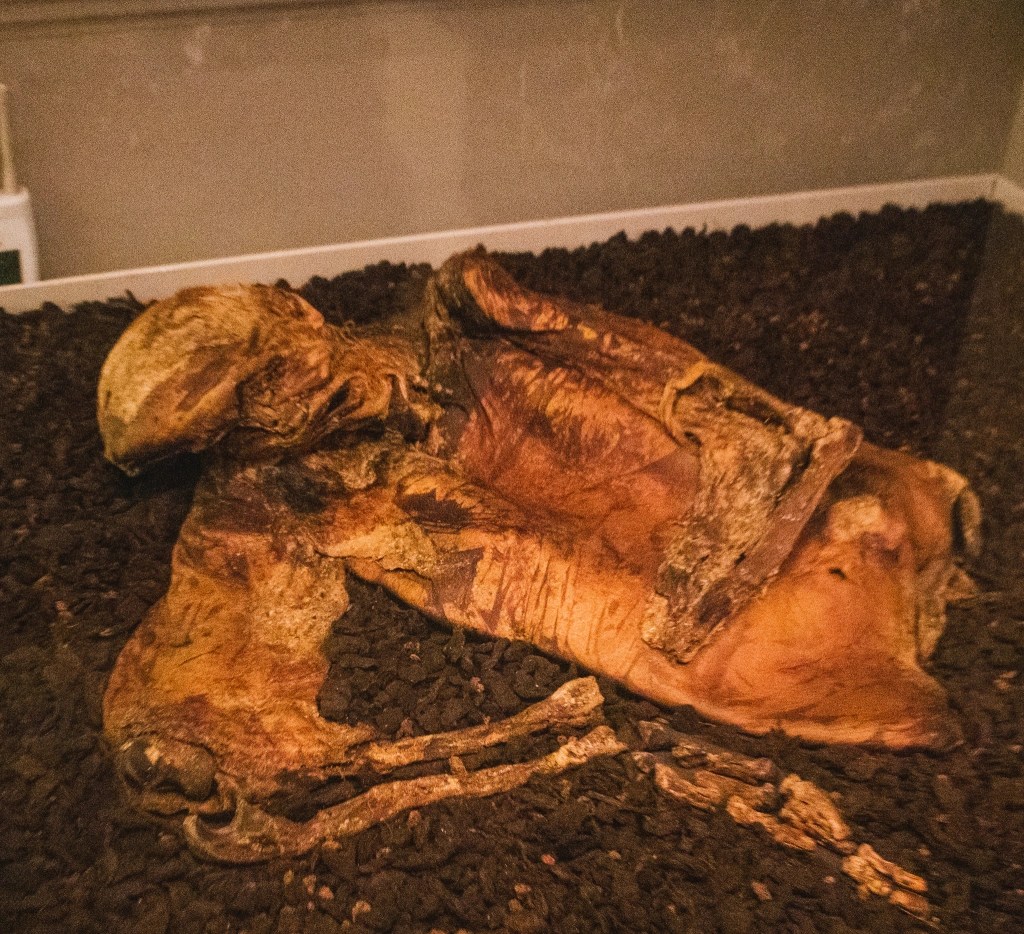
My last visit to the British Museum was in December of 2019, roughly six months before I decided that I wanted to pursue my master’s, and long before I settled on bog body displays as the focus of my master’s project. But the visit made enough of an impression on me that I wrote an article about it over on my personal blog. I was fascinated by the Lindow Man but underwhelmed by the manner in which he was displayed. He felt almost like an afterthought—second to the material culture that surrounded him.
The British Museum prides itself on many of the human remains in its possession, including its extensive collection of Egyptian mummies, but at present, the Lindow Man is largely overlooked. He rarely appears in modern marketing materials and, unless they already know he’s there, countless visitors pass through Room 50 without a second glance in his direction.
This was not always the case. Since his sensationalized discovery in 1984, the Lindow Man has been featured in a number of exhibits, each with its own approach to contextualizing his remains. In order to better understand (and, possibly, critique) the present display, there are a number of factors that must be taken into account.

The Lindow Man received significant news coverage at the time of his discovery. Public interest in the body was high—after all, he was arguably the most well-preserved bog body found in Britain up to that point, comparable to the Tollund Man and Grauballe Man in Denmark. There was little question as to whether he should be displayed; the issue instead was how he should be displayed, and what sort of treatments were required to ensure he did not deteriorate in the process.
Re-exposure to oxygen causes bog bodies to rapidly decay. For this reason, the Lindow Man was kept in cold storage at a mortuary while British archeologists consulted the specialists who aided in the preservation of the Grauballe Man and Tollund Man. It was agreed that the best option was for the Lindow Man to be freeze-dried [Omar 1989]. While this method was largely successful, there were still a number of potential threats that the preserved body might be susceptible to, including the re-absorption of moisture if his environment was not carefully regulated or infestations by bugs and other pests. Common cautionary measures include a climate-regulated case, allowing for control of the temperature, oxygen, and moisture levels in order to minimize further decay of soft tissue. Light exposure also poses an issue; bog bodies are often displayed in dimly-lit spaces, protected by UV-absorbent films [“Displaying a Bog Body”]. In the case of the Lindow Man, the information on the exact specifications is more readily available than is true of some other bodies, thanks to extensive scholarship on his conservation:
“At [the time in which the Lindow Man was first put on display], a relative humidity (RH) range of 55 + 5% was in common use for organic objects, but because of the considered sensitivity of the object the initial specification for RH was 55 + 2%. Temperature was specified at 19 + 2C and light at 100 lux with no ultraviolet (UV) radiation allowed. Because of the difficulty of achieving this specification, before Lindow Man went on display the RH was widened to 55 + 5%, and the ambient gallery temperature was accepted. Later, in 1989, the specification for light was reduced to 50 lux.”
Bradley 2008
It was later decided that the Lindow Man’s display case should include a canopy to further reduce light exposure, suggesting that these initial precautions were insufficient to prevent light damage (in fact, researchers in 2008 observed that the skin had discolored since the initial freeze-drying treatment; the source of the discoloration was not definitively determined, but light exposure was believed to be a possible culprit). According to the British Museum’s online collection, two additional conservation treatments have been performed while the Lindow Man has been in their care: a vacuum-cleaning to remove dust and peat fragments in 1997, and a light cleaning to remove debris a decade later in 2007 [“Bog Body; Arm Band; Garotte,” The British Museum].
All of the aforementioned concerns and practices must be taken into consideration when designing a display for bog-preserved remains. It would seem that the Lindow Man’s current display meets the requirements; as of 2008, researchers concluded that the body was in stable condition, presumably no longer subject to light exposure [Bradley]. While this indicates that the display has succeeded in addressing logistical concerns regarding preservation, its design leaves something to be desired.
As described at the beginning of this article, the Lindow Man is currently presented in a slightly overwhelming hall of Iron Age artifacts, covering quite a broad period. Many of these artifacts are jewelry or artwork, though the Lindow Man is not placed in direct conversation with the material culture of his time. This contrasts the vast majority of other bog body exhibitions, which are often centered around boglands or the bodies themselves. The National Museum of Ireland, for example, holds a number of well-known bog bodies found at Baronstown West, Clonycavan, Gallagh, and Oldcroghan, all of which are housed in a permanent exhibition titled “Kingship and Sacrifice.” This exhibition takes a more speculative approach to presenting the bodies: it posits that human sacrifices and the subsequent depositing of their bodies in bogs was related to kingship rituals during the Iron Age, and contextualizes the entire display around this potential explanation [“Permanent Exhibition: Kingship and Sacrifice”]. The Moesgaard Museum, which is home to the Grauballe Man—perhaps the most famous bog body ever placed on display, thanks to the work of Danish archeologist P.V. Glob—takes a similar approach, presenting visitors with other bog-related finds and a tactile, “peat-like” floor. The Statens Historiska Museum in Stockholm centers its “Prehistories” exhibit around eight life stories, some of which are focused on bodies found in bogs and wetlands, including the Granhammars Man [“Eight Life Stories”]. It is clear from these examples that there are more engaging ways that a bog body could be presented within the context of its exhibit. The Lindow Man is not currently presented as part of any narrative history any more than the pieces of jewelry and artwork are, let alone as a focal point of that history. But when the well-preserved body of an Iron Age man fails to be a focal point in an exhibit about the Iron Age itself, the exhibit is failing to do his remains justice.
The most obvious argument against this is the issue of unsuspecting visitors stumbling upon the Lindow Man. When I sat down with museum director Ole Nielsen at the Silkeborg Museum in September 2023 to discuss preservation and display methods, he speculated that perhaps this concern was an “Anglo-Saxon” one—that not every culture feels the need to shield museum-goers from seeing human remains. My own experiences visiting continental European museums would seem to agree with that assessment. Small, more localized museums (in other words, museums that do not see many international visitors) display human remains in an unabashed manner. Take, for example, the Fehmarn Museum in Burg auf Fehmarn, an island settlement in northern Germany, where Iron Age skeletonized remains are displayed absent any sort of preface or warning, in a case alongside a model ship, beads, and pottery fragments.


If some level of discomfort with human remains is indeed more prevalent in the United Kingdom or the English-speaking world as a whole, it should come as little surprise that the British Museum has relegated the Lindow Man to a quiet corner. This project has little interest in criticizing museums for adhering to cultural sensibilities. Rather, I believe there are more thoughtful ways the Lindow Man could be displayed while also taking these concerns into consideration.
The “Kingship and Sacrifice” exhibit in Ireland features spiral walls that protect visitors from coming face-to-face with the bodies unintentionally while simultaneously placing the bodies at the heart of the exhibit—the spiral shape leads visitors past relevant Iron Age artifacts and other items found in bogs until it culminates in a viewing space for the bodies themselves. A bench is provided from which the bodies can be viewed [“Bog Bodies and Curated Space”]. The Grauballe Man in Denmark is displayed in a room of his own at the bottom of a staircase, where, he can be easily avoided by guests who are uncomfortable viewing human remains, but where he is nevertheless presented within the context of his burial and subsequent discovery. The round room also features seating for those who wish to absorb what they see in what the website refers to as a “quiet and reflective space” [“The Current Exhibition”]. Also in Denmark at the Silkeborg Museum, the Tollund Man is housed in a separate room from the rest of an exhibition dedicated to bog bodies and bog-related artifacts, with lighting that turns on when guests step into the room [“Seværdighed i Silkeborg”]. All of these exhibits feature the dim lighting and climate control needed for proper conservation while also accommodating visitors who are uncomfortable with viewing human remains and would prefer to avoid them entirely.
But why is coming face-to-face with a bog body necessary for communicating these histories at all? First and foremost, the bodies themselves are the only explicit evidence we have for this kind of burial; written sources about Iron Age Germanic and Celtic cultures are primarily Roman and often second-hand accounts, with no attestations of bog burials or sacrifices. Displaying the bodies is therefore the most effective way to convey this history to the public and to provide visual evidence of the unique preservative qualities of peat bogs. Additionally, most curators and archeologists who take an interest in bog bodies seem to agree that a large part of their appeal is in their inherent human-ness—unlike skeletonized remains, many of their distinct features are still apparent, down to fingernails and facial hair. This recognizability breathes life into the past, for the average observer, in a way that artifacts and other types of remains often cannot. Bog bodies have an exceptional and unique capacity to inspire interest in and empathy for ancient peoples.
The Lindow Man himself has been moved around since his discovery in 1984, both within the British Museum and on loan to two other institutions, which means that he has been displayed in more ways than one—and arguably in more thought-provoking ways than his current display. He was originally housed in the now-defunct Archeology in Britain exhibition, which placed him in the context of recent archeological finds rather than in the time in which he lived. He was then loaned out in 1987 to the Manchester Museum before being returned to the British Museum in 1988, after which he was housed in the Central Saloon Galleries, but was subject to too much natural light, so a canopy was added to his case. Here, his position in the gallery was prominent. He was displayed alongside the Hinton St. Mary Mosaic, a 4th-century Roman mosaic found in England. It could be argued that these two items are loosely related, being Archeological finds from Iron and Bronze Age England, but how this was contextualized within the exhibit is unclear.
Jody Joy discusses how bog body displays often give thought to the context of the body’s discovery, because for many bog bodies—as is the case with the Lindow Man—the discovery of the body is as much a part of history as the body itself. In discussing various methods of designing display around bog bodies, he said:
A great deal of emphasis is placed on recreating the context of discovery in the display of bog bodies, creating the impression that they have been freshly exposed and may have ‘died yesterday’ (Giles 2009, 90; Sanders 2009, 220). For example, a cast of the underside of Grauballe Man was created before he was conserved so that they could display him in the exact position he was found in (Glob 1969, 58). Despite the fact that the body of Tollund Man was not originally preserved, they have made a replica of his body for the current display (Fischer 2012, 105–7). An exhibit at the Landesmuseum Natur und Mensch, Oldenburg, Germany, even displayed a bog body behind a huge slice of peat (see Sanders 2009, fig. 6.3). In this instance, the bog body is almost secondary to the natural phenomenon of the peat layers.
Joy 2014
Which brings us to one of the more interesting displays constructed for the Lindow Man: his second visit to the Manchester Museum on loan in 2008. In designing the exhibition, the Manchester Museum took a collaborative, community-oriented approach. As a result, “Lindow Man: A Bog Body Mystery” focused more on the Lindow Man’s relationship to the modern English people than it did on any single history. Stories from seven individuals were presented in the exhibit, ranging from the peat digger who found him to a Druid. Rather than Iron Age artifacts, it featured a range of objects like a peat-digging shovel and a pagan wand. The exhibition was controversial, both in academic circles and among visitors. But as Joy notes in his essay, the Manchester Museum’s exhibition generated far more thought-provoking discussion than did the more traditional Iron Age exhibition that followed in Newcastle.
And then, the Lindow Man was returned to the British Museum, where he currently resides in the corner of Room 50 with little to indicate why he is there or his significance to the Iron Age exhibit. His body lies on a bed of dried peat, alongside a photograph of the Lindow Moss where he was found, loosely contextualizing his body’s discovery in 1984. A handful of panels cover some basic questions: What do we know about the Lindow Man? Why did he die? Why did he last so long in the bog?
His current display is functional, but it does not generate interest. It does not present his body with the same respect for the dead as the quiet, contemplative rooms of the Grauballe Man or the Tollund man; it does not emphasize the significance of his discovery or the potential histories in the way the National Museum of Ireland or Statens Historiska Museum’s displays do; it does not challenge us with different perceptions as did the display at the Manchester Museum. Most importantly, it fails to give his humanity a significant role in the exhibit. Room 50 encourages us to admire Iron Age artifacts, but it fails to encourage us to engage with the people who made them. Contrast this with other bog body exhibitions, or with the British Museum’s own Egyptian displays, and it perhaps begins to feel like a missed opportunity.


 The Bog Body Resource
Leave a reply to Bog Bodies at Schloss Gottorf: The Osterby Head – Bog Body Database Cancel reply