
Strange as it may sound, one of the perks of moving to New England—for me, anyway—has been easier access to peatlands. I’m originally from Southern California and my previous encounters with bogs had all taken place oversees. A couple months after making the move cross-country, I visited the Orono Bog Boardwalk in Bangor City Forest and was impressed with both how easy it was to find (European bogs, in my experience, are not always easy to track down) and its popularity.
My graduate program required me to complete two internships. Given my interest in peatlands, the Orono Bog Boardwalk seemed like an interesting and relevant internship opportunity. My hope was that I might learn more about the ecology of peatlands by working at the bog. I reached out to the boardwalk director and arranged to work a docent position over the summer.

Docents are stationed in a cabin near the trail entrance, where they are available to take a tally of visitors, document any wildlife sightings, answer questions, accept donations, and sell souvenirs including hats, books, stickers, and T-shirts. Prior to starting my internship, I attended a one day training session on opening, closing, and emergency procedures. Otherwise, it was left up to docents how knowledgeable they made themselves about the bog itself. I focused on educating myself on the ecology of northeastern peatlands.
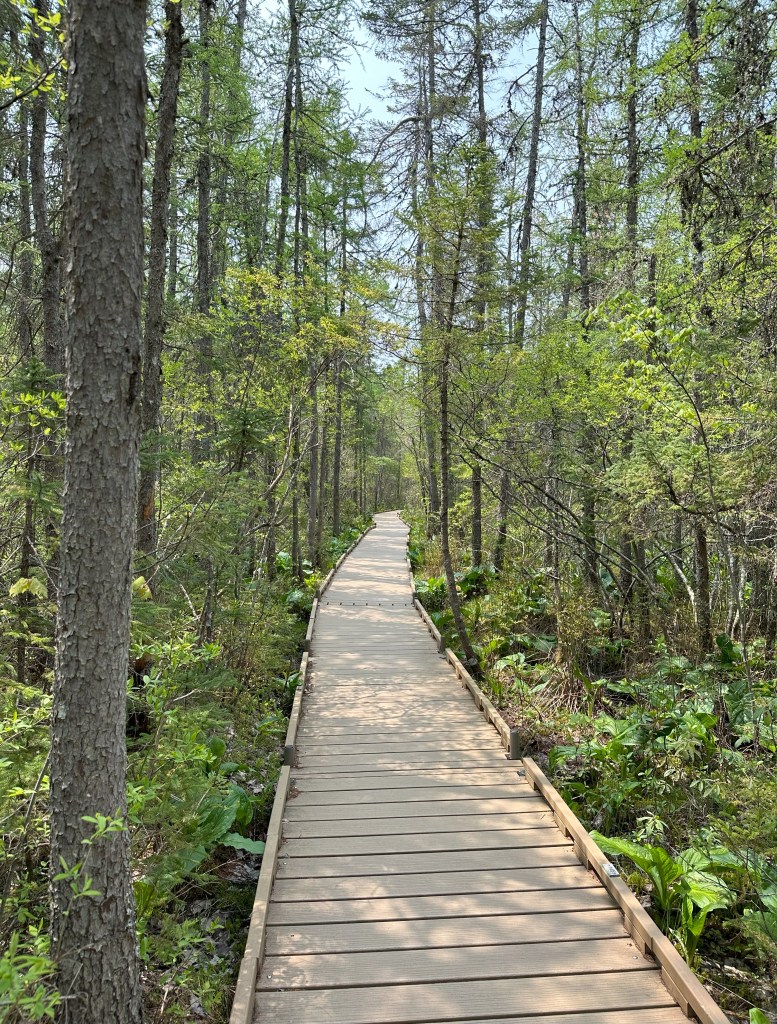
According to the National Park Service, the Orono Bog was made a National Natural Landmark in 1973 (the marker pictured above was placed in 1974). However, it wasn’t made publicly accessible until 2003 thanks to the installation of a floating boardwalk. The boardwalk comprises an approximately one-mile loop trail with educational signage at various points throughout. It passes through the various stages of wetland, beginning with a raised wooded fen and culminating in the moss lawn of the raised bog, pictured on the map before the start of the trail.

Peatlands are not uncommon in the northeastern United States, but many are inaccessible to the public. Ecology of Peat Bogs of the Glaciated Northeastern United States defines a bogs as “nutrient-poor, acid peatlands with vegetation in which peat mosses (Sphagnum spp.), ericaceous shrubs, and sedges (Cyperaceae) play a prominent role. Conifers, such as black spruce (Picea mariana), white pine (Pinus strobus), and larch (Larix laricina) are often present” [Damman]. Orono Bog is classified as an ombrogenous or raised peatland, with the moss lawn sitting above the groundwater level and sustained by periodic rainfall [“Ombrogenous Bog”]. This is the variety of peatland that typically produces the bog bodies we’re familiar with, but if any such burial practices existed among the indigenous peoples of the northeast, their remains are protected from exhumation by NAGPRA.
Still, this does not prevent visitors from inquiring about bog bodies. The Bangor City Forest website touches on western European beliefs about bogs and there was one school group visiting Orono over the summer who specifically requested that the tour guide discuss bog bodies with the children. While docenting, I was always excited to answer bog body-related questions. While we may never know whether Orono Bog is the final resting place for any human remains, the same processes have undoubtedly preserved the remains of animals who met an unfotunate end in the bog, and the subject obviously holds a sort of morbid appeal among the public.
Of course, the boardwalk drew visitors with a wide array of interests, including birdwatchers, amateur botanists, tourists, and hikers. It is wheelchair accessible, which is an advantage over more traditional nature trails.
It is interesting to compare the Orono Bog Boardwalk to European bogs like Bjaeldskovdal Peat Bog in Denmark, which I visited in September not long after finishing my internship at Orono. Being that Bjaeldskovdal was previously drained, there is little need for a floating boardwalk to protect the natural flora; however, I would imagine that the resulting dirt path is less accessible. It is worth noting that some better-preserved European bogs do utilize boardwalks, including the Clara Bog in Ireland and the Great Kemeri Bog in Latvia. I felt that Bjaeldskovdal’s site markers for the discovery of the Tollund Man were more engaging than the trail markers at Orono, largely because those at Bjaeldskovdal are multimedia.
 The Bog Body Resource
Leave a comment